
An expansion shaped by time, dialogue, and restraint. Planet Traveler grows within Kensington Market through careful negotiation with heritage, community, and the lived rhythms of the city.
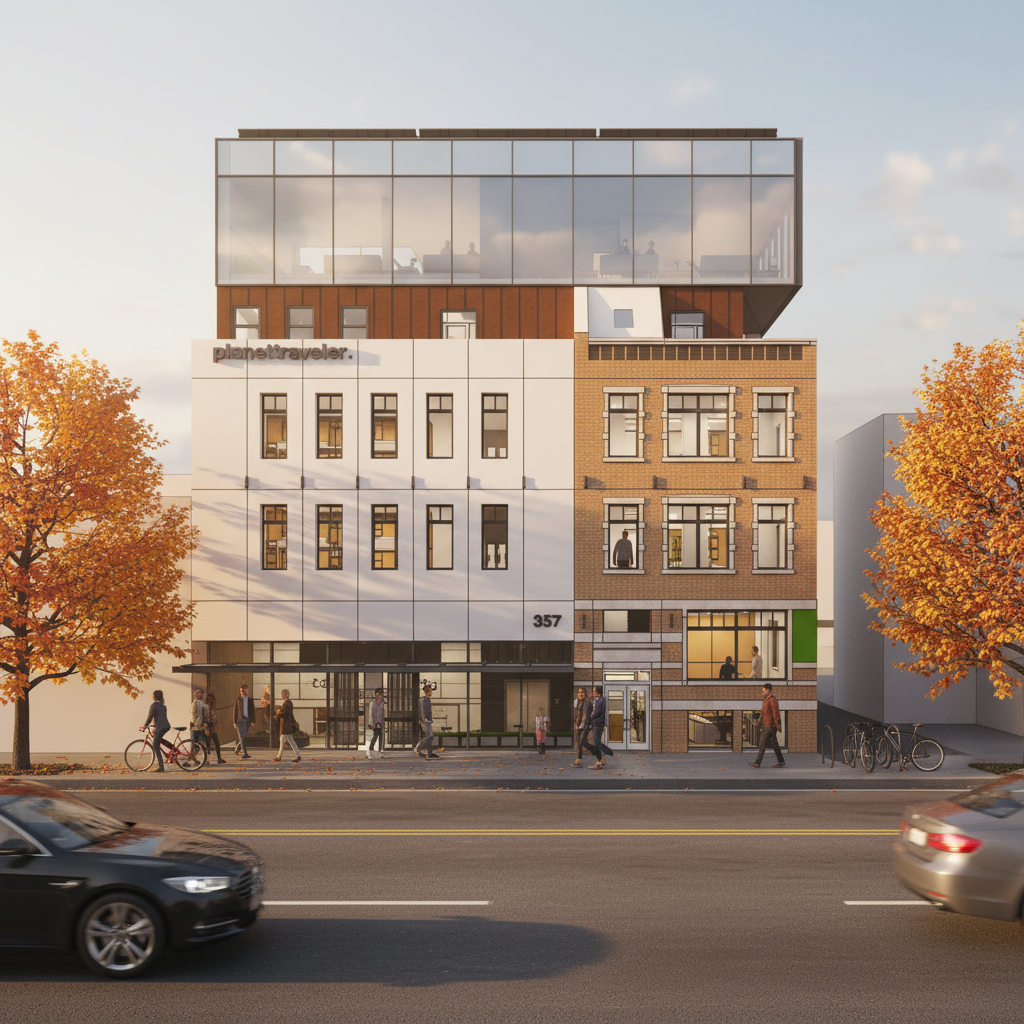
Planet Traveler — An Expansion in Dialogue
Kensington Market, Toronto
Planet Traveler has always been more than a hostel. It is a pause in the city — a place where movement slows, languages overlap, and strangers briefly belong to the same room.
Rooted in Kensington Market, one of Toronto’s most layered and human neighbourhoods, the building has long lived at the edge between local life and global passage. The expansion emerges from that condition — not as an act of scale, but as an act of listening.
This project is the result of time. Nearly a decade of conversations with the city, with heritage, with community, and with the realities of operating a living building. Growth here was never about adding rooms alone, but about asking a quieter question: how can a place grow without losing its soul?
The approved design extends the building vertically and laterally — a fifth floor above, a new east wing alongside — carefully negotiating mass, light, and rhythm. Roof terraces and patios introduce moments of air and pause, allowing the building to open upward rather than press outward. At street level, cultural and retail spaces maintain permeability, keeping the ground plane active, porous, and shared.
Rather than asserting itself, the architecture responds. It follows the grain of Kensington — its irregularities, its density, its refusal of polish. The expansion is intentionally restrained, allowing the life within and around it to remain the primary author.
Hospitality here is treated as civic space. A hostel not as a transient container, but as social infrastructure — a place of exchange, rest, and informal community. The project embraces this responsibility, weaving private and shared moments into a coherent spatial narrative.
Behind the scenes, the work demanded patience and fluency: navigating planning frameworks, heritage sensitivities, operational realities, and long timelines. The process itself became part of the design — a slow calibration between intention and permission.
What emerges is not a statement of ambition, but one of stewardship. An expansion that respects the city’s memory while making room for new stories.
In a time when speed often replaces care, this project insists on another pace — one that values continuity, belonging, and the quiet intelligence of staying with a place long enough to understand it.